Impacts to the American Public Dashboard
This interactive dashboard to showcases the personal impact these terminations had on respondents. Below there is a report with static images of the same information for readability, to publish, and for printability. There may be slight variations between data shown on tableau and in static images.

Impacts to the American Public Report
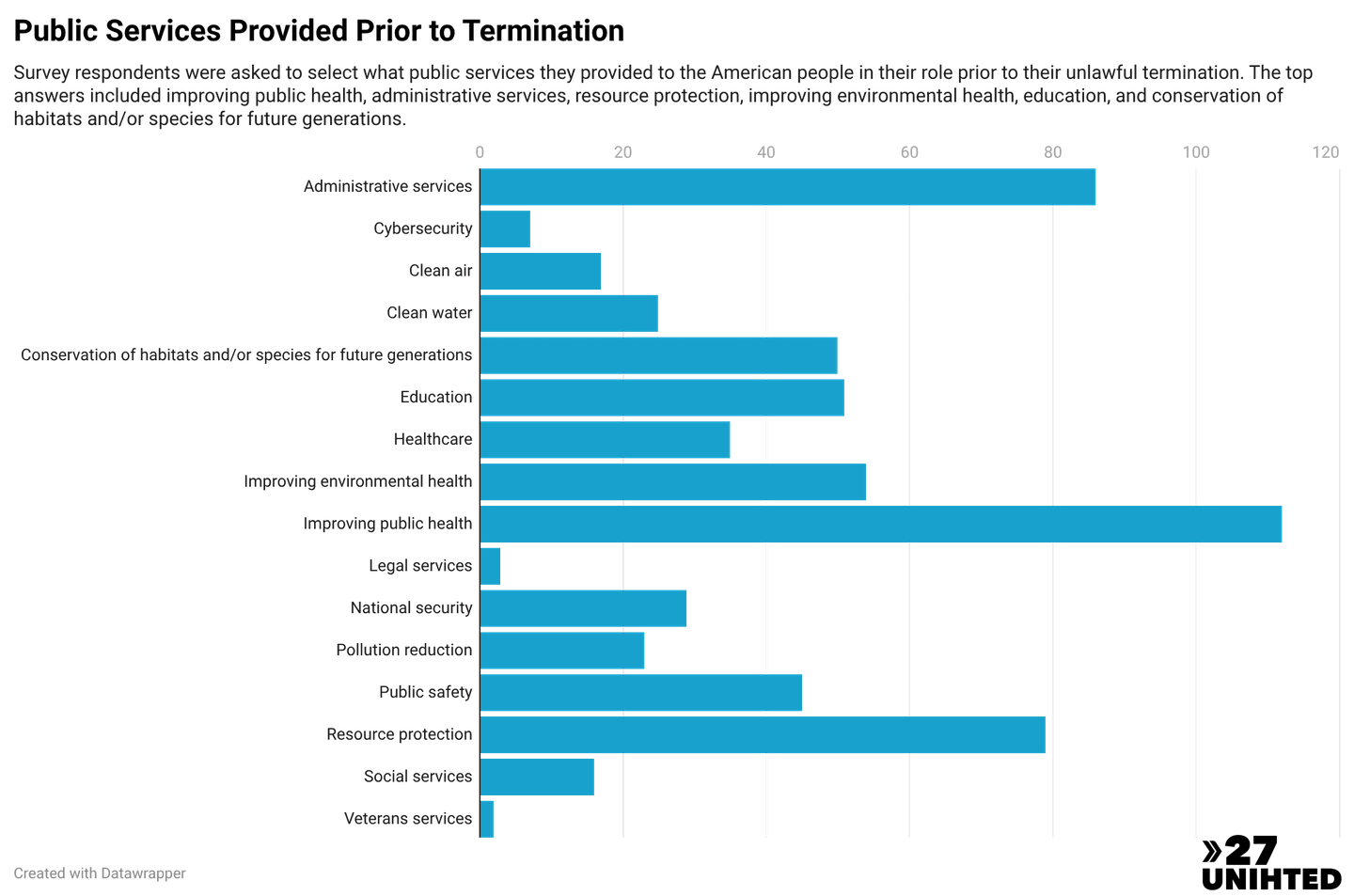
The fired federal workers who responded to this survey came from agencies that touch nearly every aspect of American life. They were scientists, public health professionals, conservation officers, legal experts, researchers, communications specialists, and more. The largest share worked at the Department of Health and Human Services, followed by the Department of Commerce and the Department of the Interior. These were people actively improving public health, protecting natural resources, maintaining environmental health, ensuring public safety, and safeguarding national security. When they were fired, the work did not stop needing to be done.
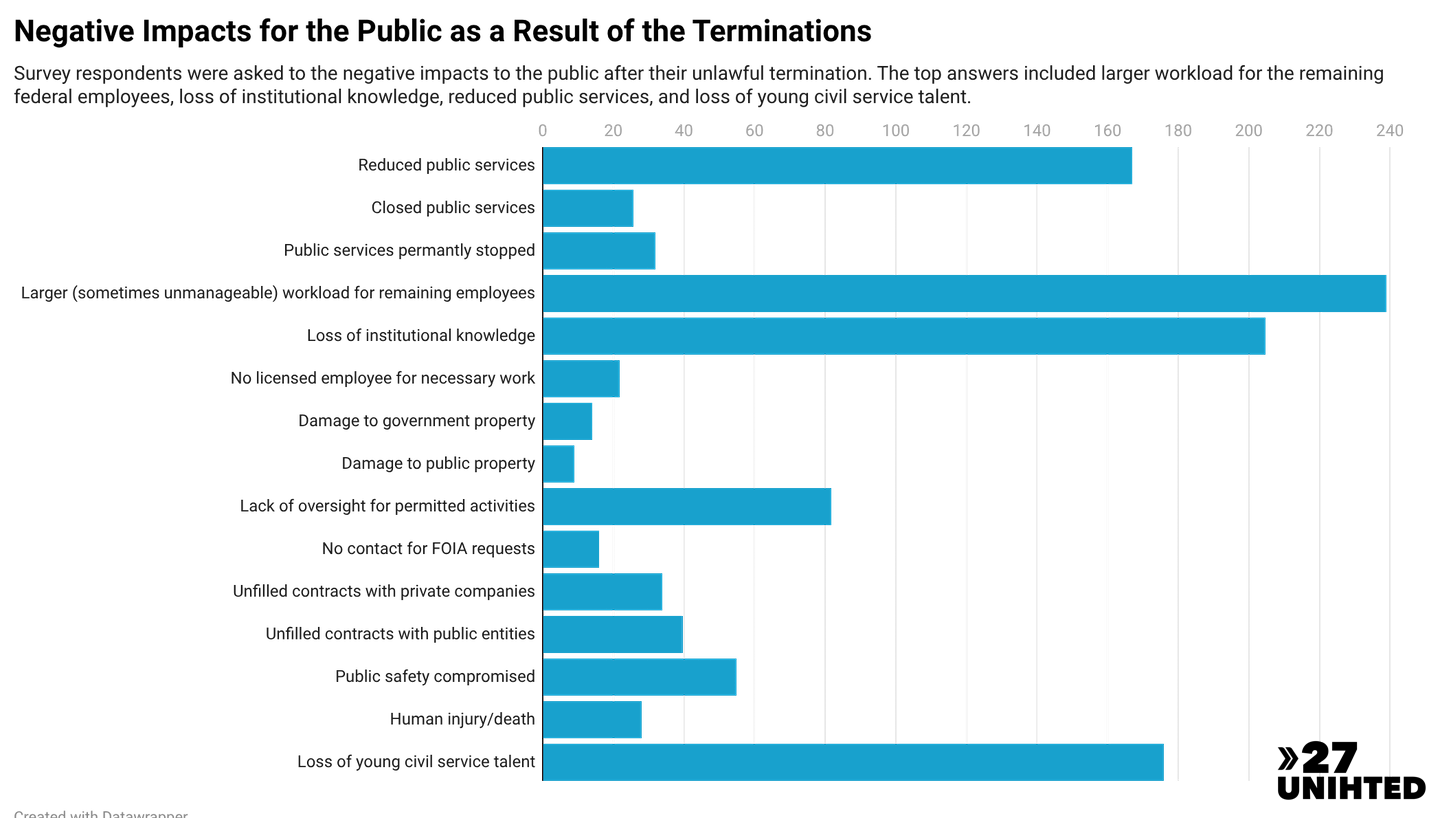
The breadth of services these workers provided makes clear the repercussions of these firings will be felt throughout the nation. The most commonly reported consequence of these terminations was a larger, sometimes unmanageable workload for the federal workers who remained, reported by approximately 240 survey respondents. Close behind was the loss of institutional knowledge, reported by roughly 210, followed by the loss of young civil service talent at 175, and reduced public services at 165 respondents.
Public health programs were disrupted. Environmental monitoring was reduced. Conservation work stalled. Healthcare access slowed. National security oversight weakened. The graphs below show both who these workers were and what they believe has been lost, in their own words and in their own data.
These are not abstract organizational concerns. They translate directly into slower response times, reduced oversight, degraded services, and in some cases, risks to public safety and human life. A significant number of respondents also flagged lack of oversight for permitted activities and compromised public safety as direct consequences of the firings.
Impacts to Federal Civil Service
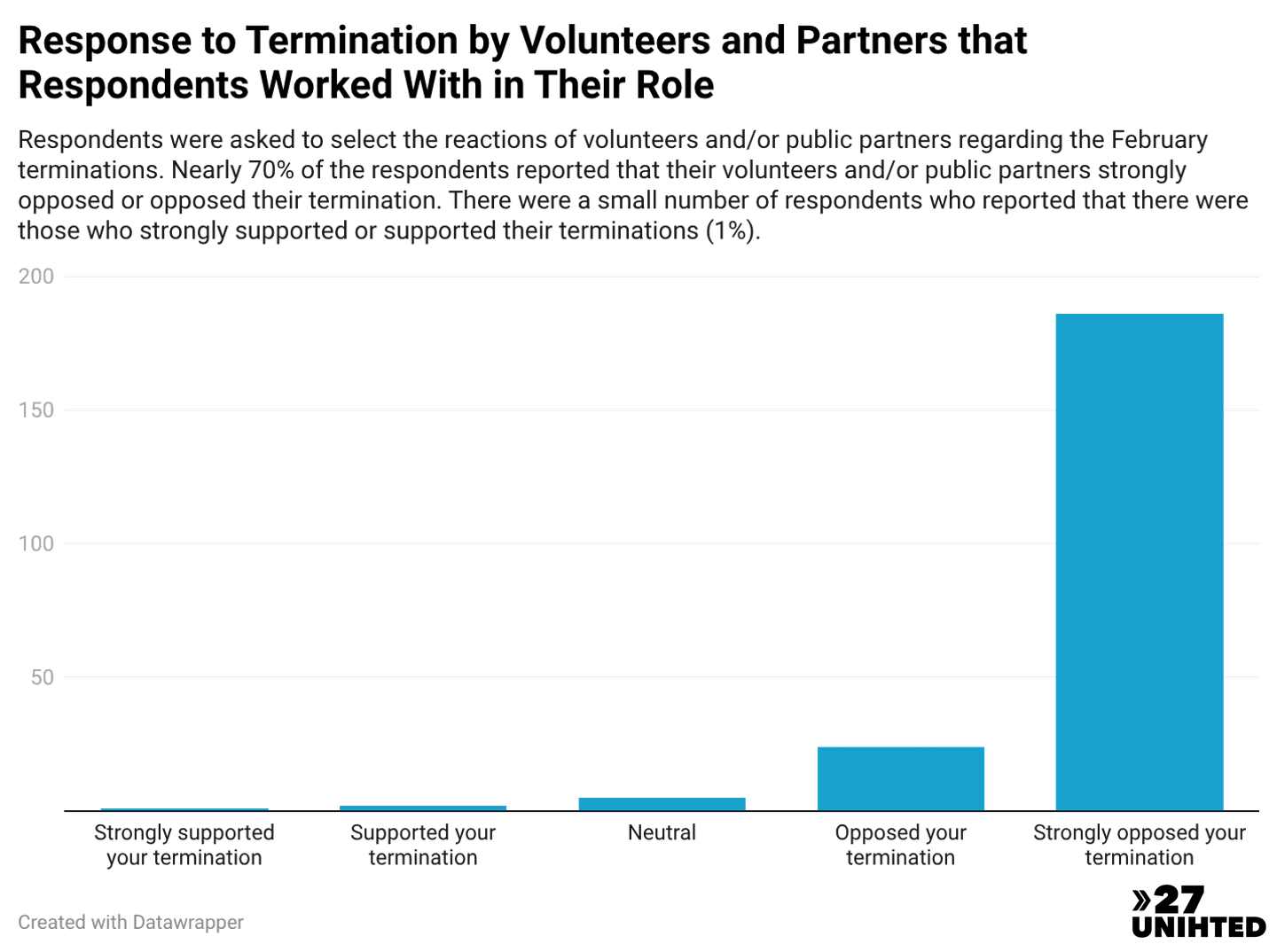
The public organizations that worked with respondents did not support their unlawful terminations either, according to respondents.
Two hundred eighteen respondents self-reported that they had worked with public counterparts, such as state and city employees, volunteers, public landowners, and nonprofit workers. Ninety-six percent of these public counterparts either "strongly opposed” or “opposed” the terminations of the probationary employees, demonstrating a lack of public support for the firings from the organizations with whom respondents worked.
Contractors Prior to Federal Employment
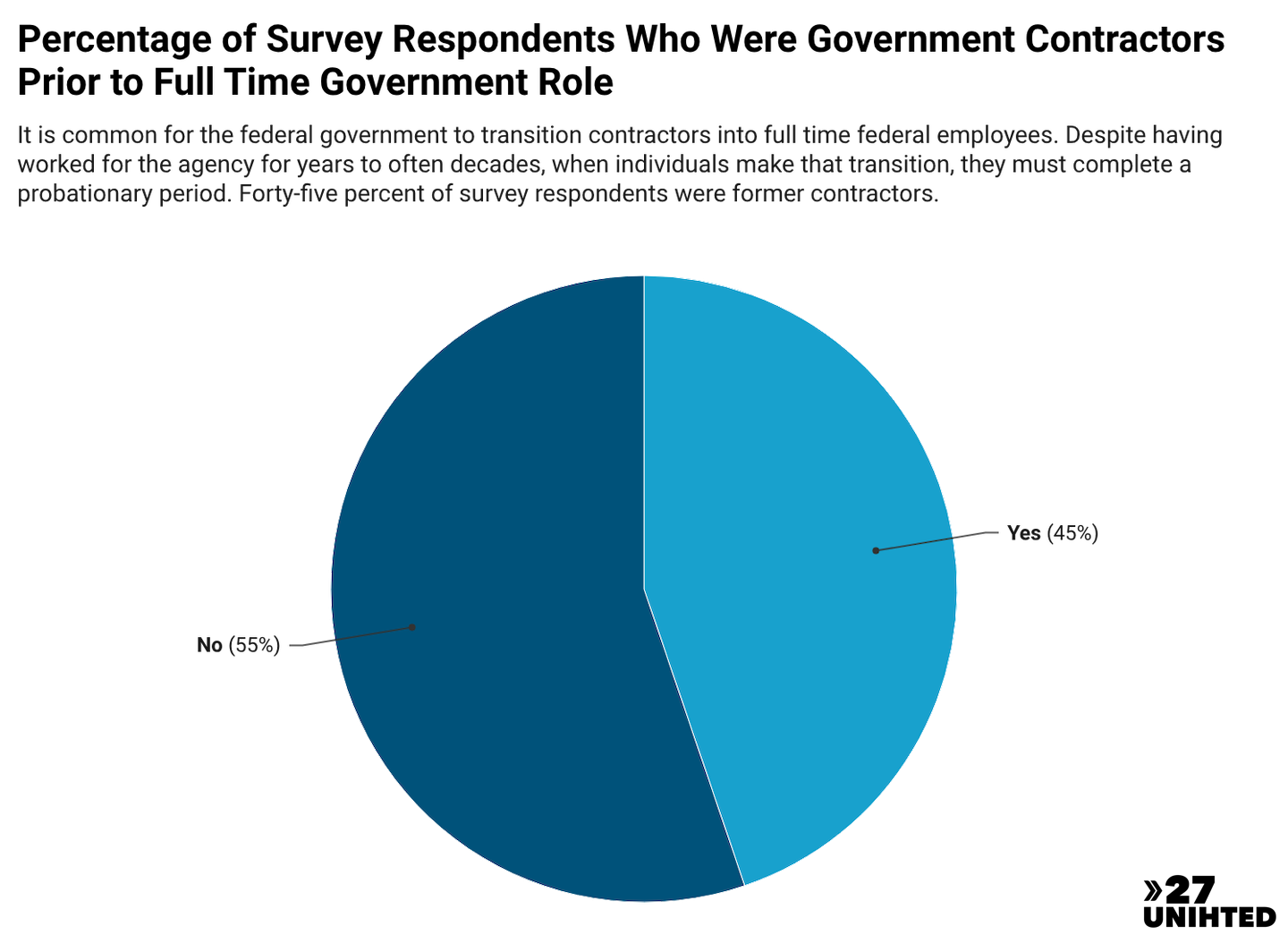
It is common for the federal government to transition contractors into full time federal employees. Despite having worked for the agency for years to often decades, when individuals make that transition, they must complete a probationary period.
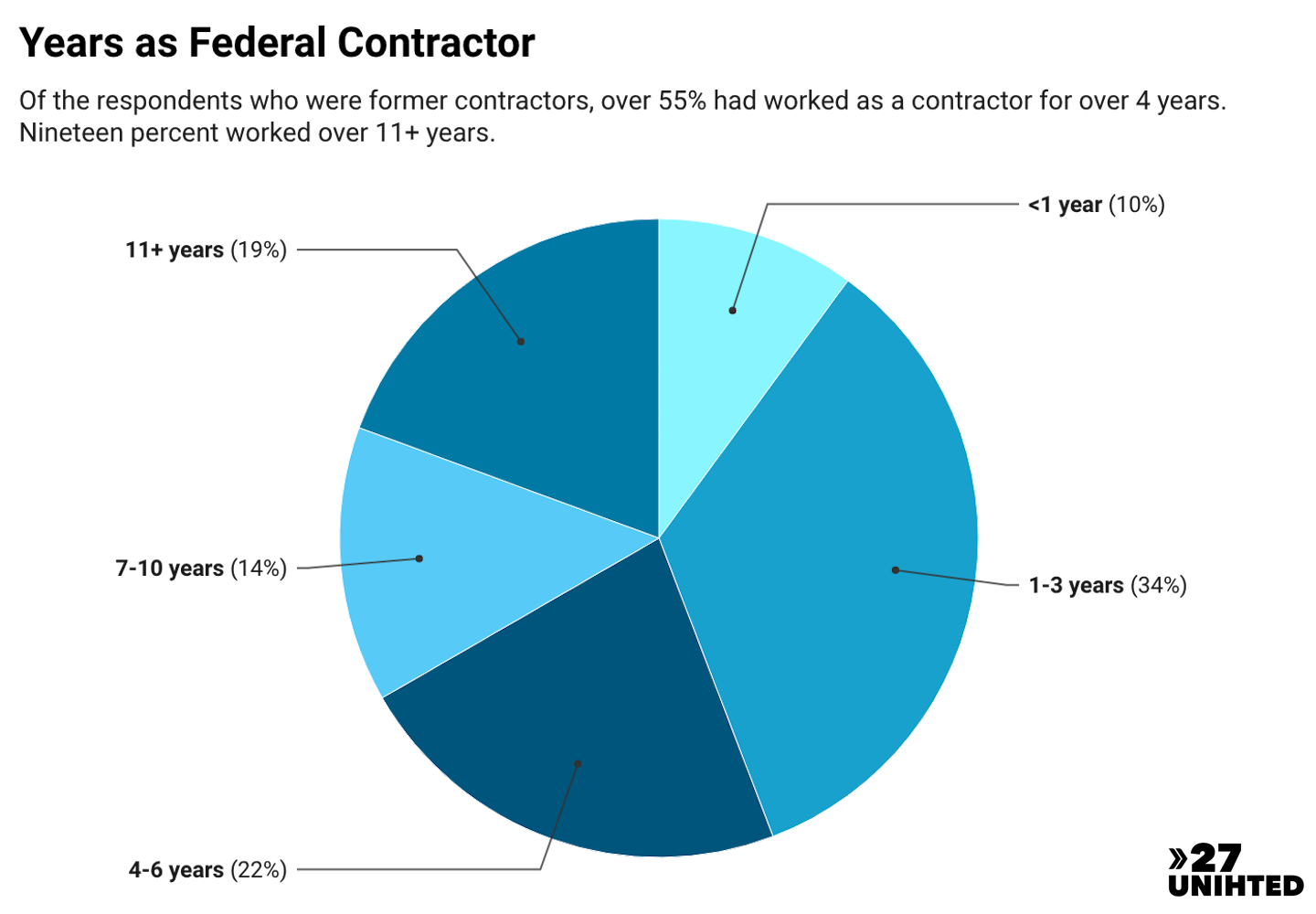
Many probationary employee respondents were former contractors: about 45% of the respondents had been contractors in the federal government before they transitioned into their full time role. Of those who were former contractors, over 55% had worked as a contractor for more than 4 years. Nineteen percent worked 11 years or more.
The loss of these probationary employees means that the government workforce lost decades of specialized experience and institutional knowledge.
It can cost significantly more to the government to employ contractors than their federal counterparts; contracting companies charge fees, while contractor employees may make less than federal employees (although this exact number is too complicated to analyze perfectly here.)
This may have cost our government more than if they had kept new federal employees in their current roles.
The federal workers who responded to this survey were not entry-level hires. They were the product of years of deliberate investment by the agencies that trained them, the recruiting programs that sought them out, and by their own hard work.
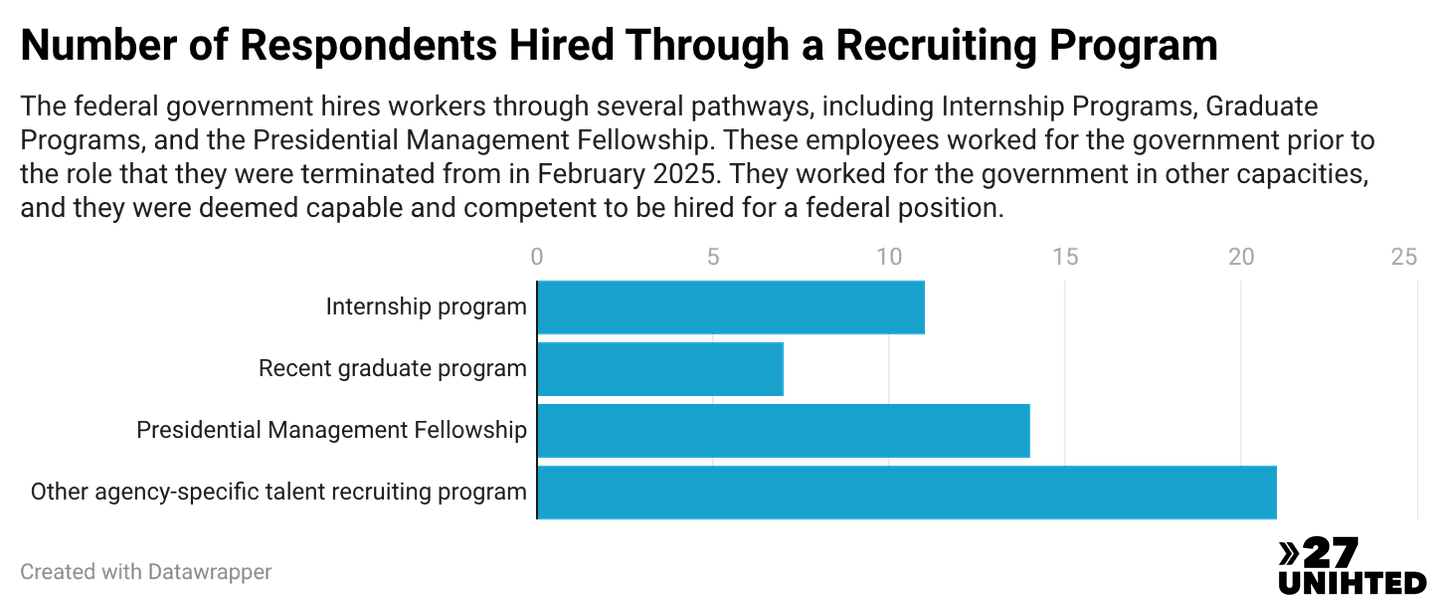
The federal government can hire workers through several pathways, including internship programs, graduate programs, and the Presidential Management Fellowship. These recruitment pathways frequently provide participants with on-the-job experience and education.
Fifty-three of the survey respondents replied they had been recruited through one of these programs. This means that these employees worked for the government, working in other capacities, and they were deemed capable and competent to be hired for a federal position prior to their termination.
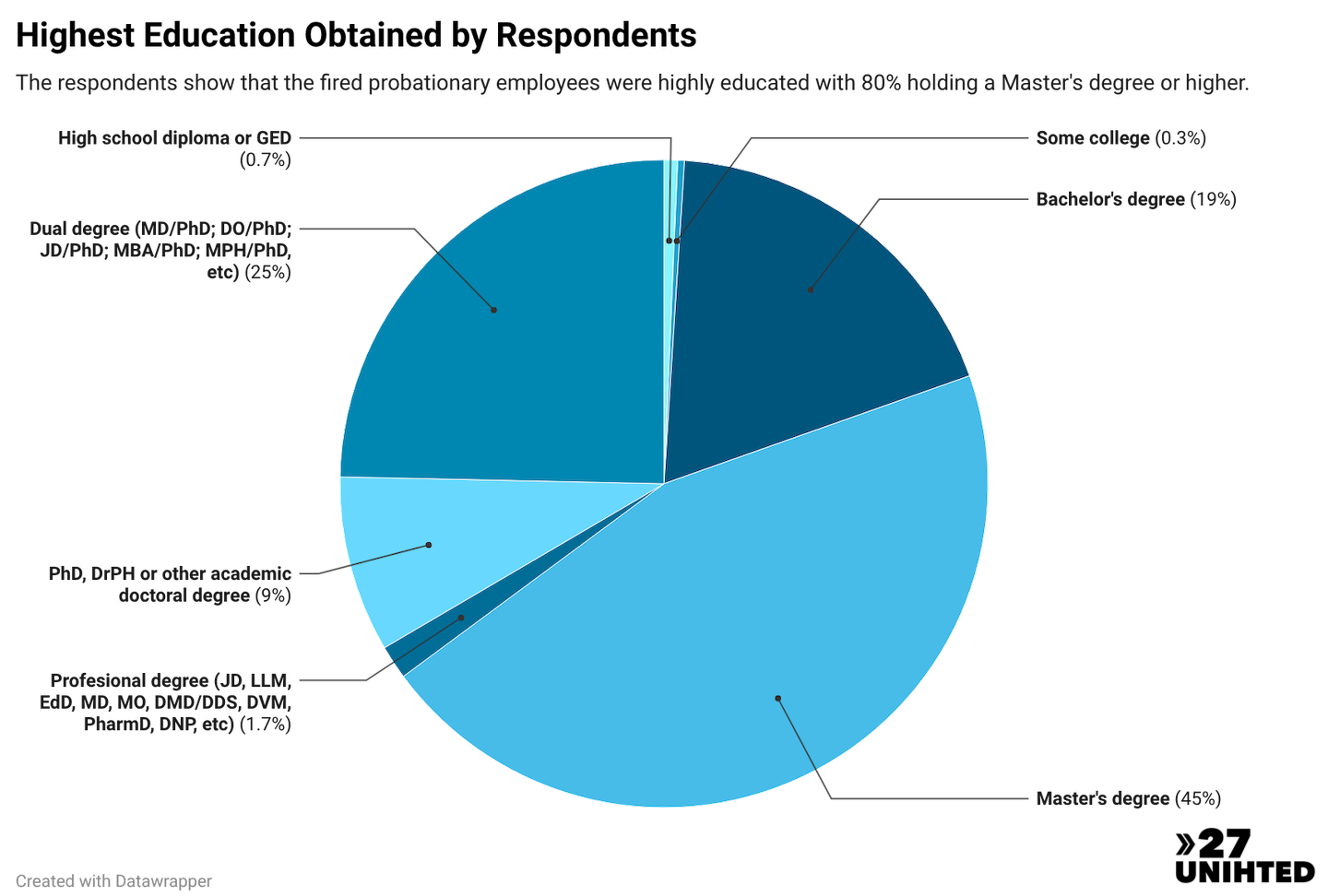
The respondents to this survey were a highly educated group with over 80% having a master’s degree or higher, and 99% had a bachelor's degree or higher. Thirty-three percent of respondents hold a doctorate degree or dual degree (PhD, MD/PhD, or equivalent).
Firing these federal employees means that the government workforce lost individuals who had dedicated themselves to learning as much as possible about their fields and gained expert knowledge and skills that are not easily replaceable. It takes years, sometimes close to a decade, to attain a PhD. Now, these respondents are unable to apply their skillsets in the employment area in which they were hired, to do careers they trained for that directly supported the American public.
When probationary employees were fired, the government did not just lose workers. It lost the investment it had made in them: the training, the clearances, the institutional knowledge, the specialized expertise built over careers, and more.
New Employment and Returning to Federal Service
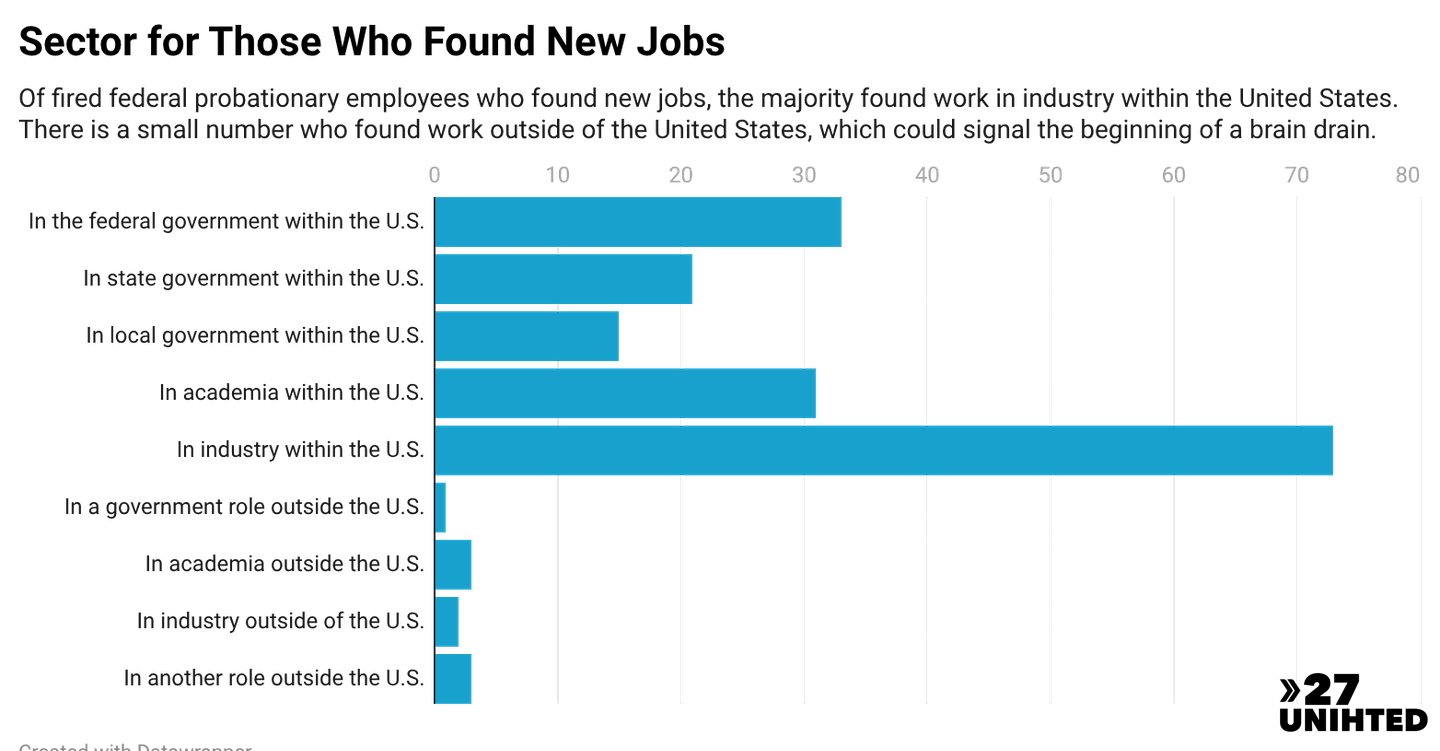
Of the 298 respondents who provided information on their new job sector, only 11% have returned to work as civil servants in the federal government.
Nearly half of these 298 respondents are now employed within the U.S. in non-federal jobs, such as roles in industry, academia, or state government. This shows that these employees have left the federal government for new work, leaving the government workforce to suffer.
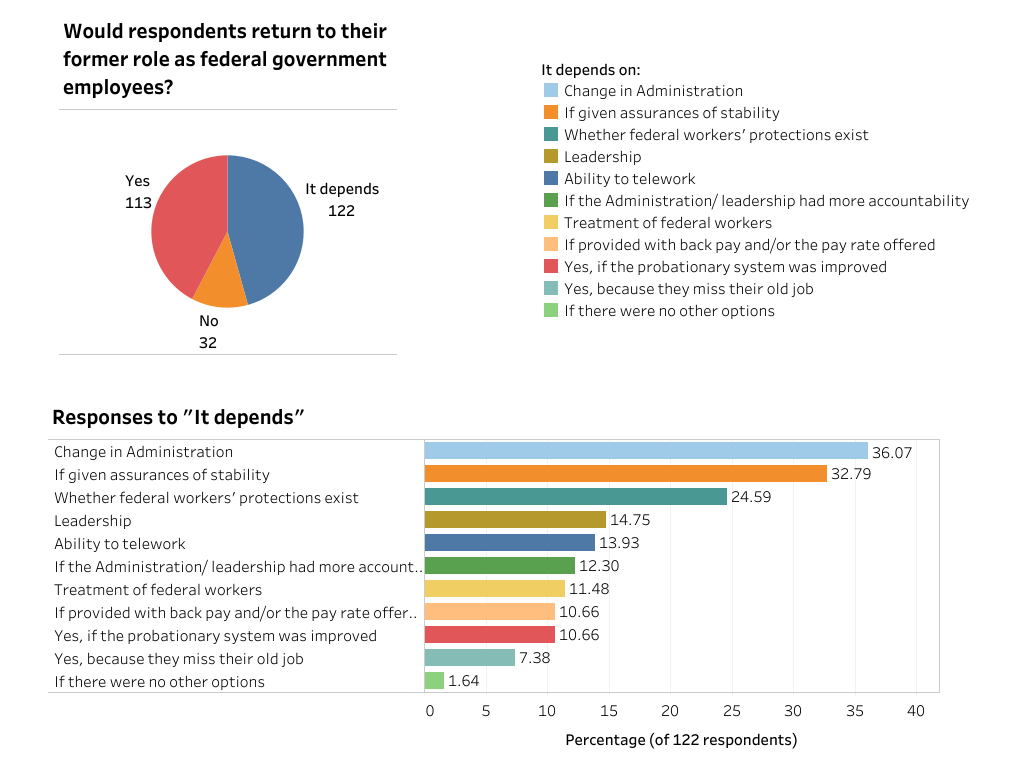
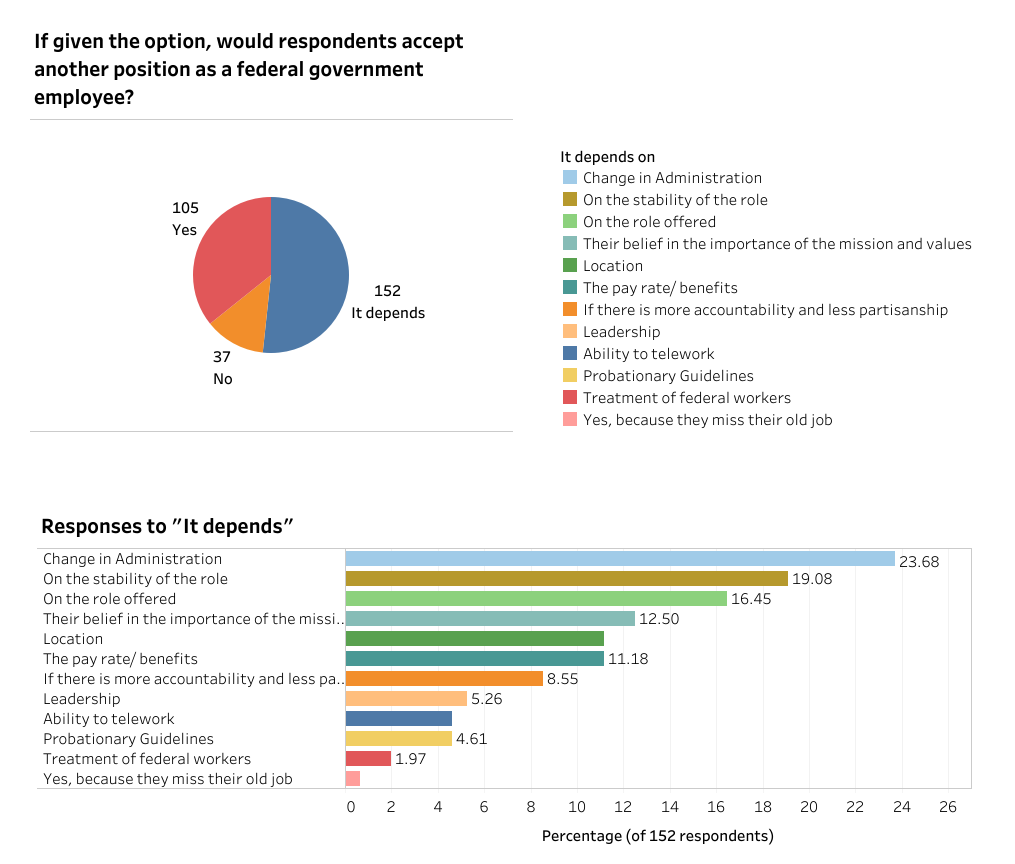
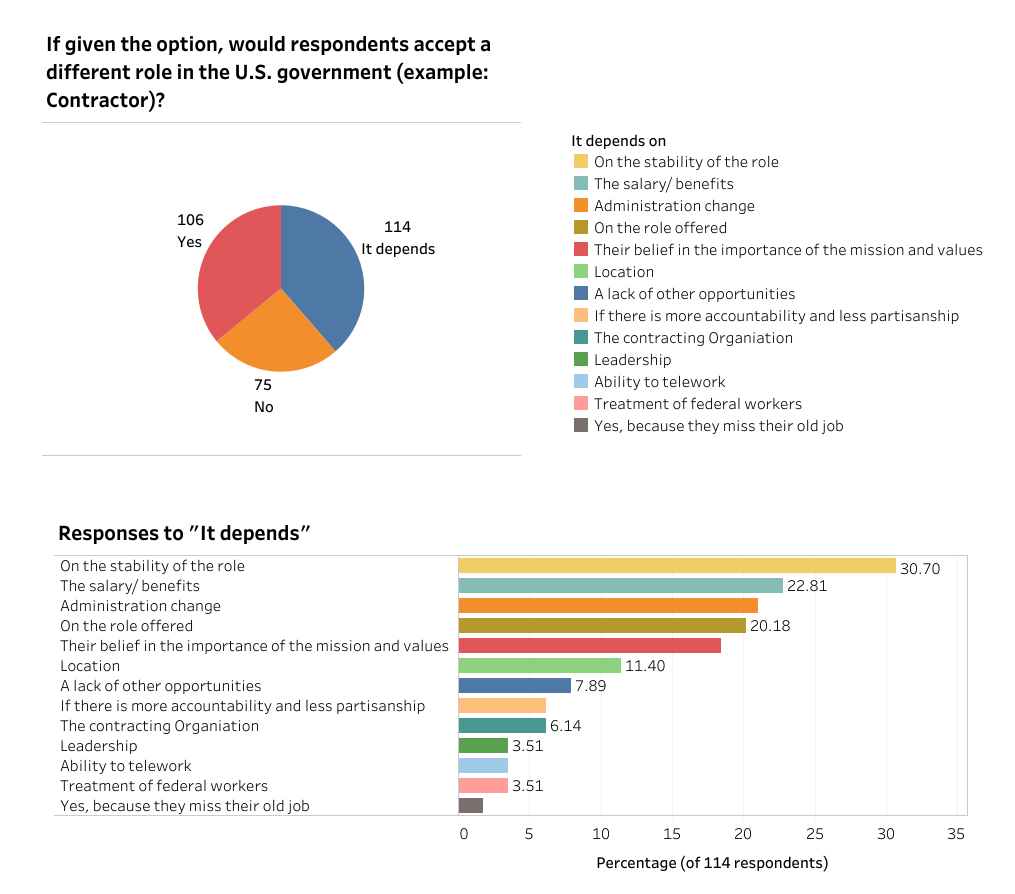
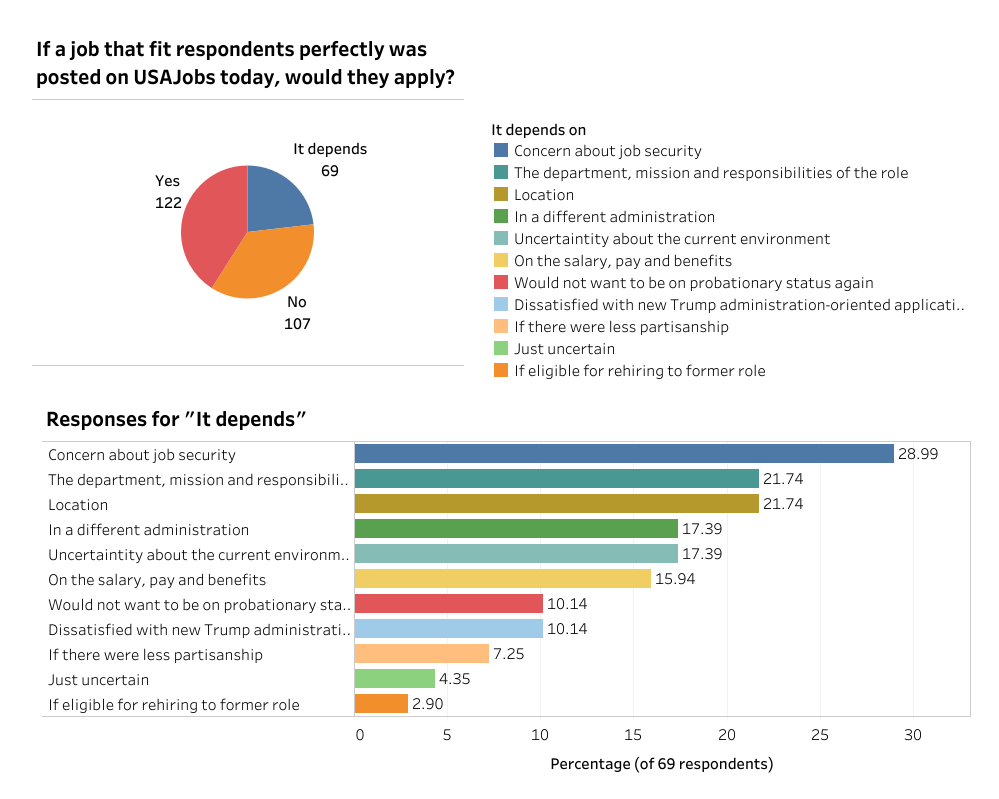
The last four images explore whether respondents would consider returning to the civil service, if given the opportunity.
For some, this was a simple “yes” or “no,” but for others, it is a nuanced and difficult topic to address. Being illegally fired from their federal jobs had a huge toll on respondents’ mental health (for details see our dashboard on “Personal Impacts & Effects on Mental Health”), as well as causing financial stress, as seen in other responses.
Many respondents expressed concern about returning to the federal workforce because of fear that they would be targeted in future unlawful actions against federal employees. Others were concerned about growing partisanship in the government, while others worried about being asked to relocate and uproot their lives without any reassurances of a stable career.
Conclusion
The data from the respondents make it clear that the public will suffer as a result of these unlawful terminations. The U.S. government structure and ability to serve the public is also suffering due to the loss of experienced and highly educated workers. Many of these workers are unlikely to return voluntarily to the federal service soon because the most common requirement for their return was a change in administration.
*Disclaimer: The survey did not request that respondents provide personal identifying information (PII), and results are published as aggregated responses for each question. Organizers did not verify the identity or status of respondents, and respondents self-selected to participate. No single question required an answer. Thus, the percentages for each question share only the respondents’ answers for that particular question, meaning the totals vary throughout the results. Respondents did not receive an incentive to complete the survey; participation was completely voluntary. This is not a research project.